Wednesday, July 23, 2014

I wuz plagiarised by a Publisher!!!

[As can be seen in the comments section to this post, the author of the book got in touch with me - turns out we're both victims here, thanks to the publisher. So I've rewritten both my Amazon review and some parts of this blog post to reflect what actually happened.]

Well, not quite the right word, but I basically had some of my intellectual property swiped without permission (which I probably would have granted, had I been asked).
Some history: back in December of last year I took a picture of three daggers in my collection, one of which I hand made myself. I eventually uploaded this picture to Wikimedia on February 8th, 2014 (according to the change page log on Wiki). The picture can be seen here:
https://en.wikipedia.org/wiki/Dagger
It is about halfway down the page, in the sub section on Mediaeval daggers. I put it in to better illustrate the section, and I give explicit details in the photo description as to what the reproductions were based on and who made them. Now, before going further let me post the verbatim of the Creative Commons license on Wiki that applies to this photo:

"You are free:
  • to share – to copy, distribute and transmit the work
  • to remix – to adapt the work
Under the following conditions:
  • attribution – You must attribute the work in the manner specified by the author or licensor (but not in any way that suggests that they endorse you or your use of the work).
  • share alike – If you alter, transform, or build upon this work, you may distribute the resulting work only under the same or similar license to this one."

Note well that one must attribute the work, and that one must also share alike. While a rational human would interpret that latter to mean that one could not take something that was made available for free and turn it around and use it in a for profit work, that is not how the Publisher interpreted it, alas...
Some months ago I bought a book on the bargain table at Barnes & Noble entitled "Knives, Daggers & Hand-Combat Tools" which can be seen here on Amazon: http://www.amazon.com/Daggers-Hand-Combat-Illustrated-History-Weapons/dp/174363059X/ref=sr_1_1?s=books&ie=UTF8&qid=1404410862&sr=1-1&keywords=Daggers
It seemed like a well illustrated, if overly broad, treatment of the subject, but I had glanced quickly through it and figured it would be a nice add to my library. All well and good but imagine my surprise when I turned to page 47 and saw this:


If you compare with my picture on Wikipedia, you can see immediately that the Publisher took my picture, edited it (rather nicely, though, I will say) and then used it to illustrate their book which they now sell for a profit.

Now, there is a page at the end of the book with the following note: "Unless otherwise noted, all silhouetted weaponry  images are from the Berman Museum of World History, Anniston, Alabama, and photographed by f-stop fitzgerald and Jonathan Conklin Photography, Inc., with the exception of the following:" They then list a bunch of photo credits from various sources. Nowhere, however, do the Publishers acknowledge the source of the photo with my daggers, let alone who made the reproductions (which I clearly attribute in my blurb on Wikipedia describing the picture).


As an aside I saw a few other pictures that they got out of Wikipedia, as well, for their book. Thing of it is, if the Publishers had simply asked I probably would have given permission to use freely (provided they credited me; additionally, though not strictly necessary, a free copy of the book would have been a most kind gesture of "thanks"...). Honestly I was a bit flattered that they considered my picture (and, by extension, the dagger I made) to be worthy of inclusion in his book. But the Publisher really dropped the ball here, and will make me rethink how I distribute pix of my work in the future.


Interestingly, had the Publisher worked with me, I could have provided more and better pictures of reproduction daggers in my collection, that would have been even easier to edit and use (for example, I could have taken good closeups of the pommel, etc., that they had to do a photo edit on from the base picture, reducing the quality).


Another related problem I have with some of the illustrations that are in this book, where they are photos of modern reproductions, is that the makers are not credited by the Publisher. This has nothing to do with copyright, but rather with letting the makers get a bit of advertising - I'm sure some folks look at some of these reproductions and think "I'd like one". Would be nice to know where to go...


One detail that got tripped up is that they took a photo of a reproduction Landsknecht dagger from Arms & Armor to illustrate the type. However, while they do state it is a reproduction, they claim it is based on an example from the Solingen Blade Museum in Germany. This is wrong; the reproduction in question is conjecture based on what a companion dagger might look like based on the extant example of a Katzbalger sword from said museum - no such dagger, as such, actually exists. While it is a plausible reconstruction, there is no direct example.
Many thanks to the author for clarifying the situation with me. He confided that he was so concerned about some of the issues he had seen pre-publishing that he wanted his name taken off and a pseudonym used instead, but the Publisher didn't even do that! Sad state of affairs all around. While I've always been dimly aware that authors get "p'wnd" to some degree, I had no idea it was this bad.
As noted, I've updated my Amazon review accordingly. Knowing what I know now I'd say this is actually worth getting, as there are some interesting photos in it, not the least being the daggers out of my collection... :-)

Thursday, July 3, 2014

On Combat in D&D and Melee – Perceptions and Reality

A while back I ran into this screed by an old wargamer who calls himself T. Shiels that used to be at this website (http://www.thortrains.net/armymen/index.html) but no longer seems to be extant. In spite of its apparent disappearance, I feel compelled to address it, since it has often been cited particularly in conjunction with so called “Old School” gaming forums as a basis for justifying not having any differentiation between weapon types – a silly proposition but one that gets traction from diatribes such as these:

"After my Army tour, I lived a bit too wild and got involved in too many scary episodes. It seemed like wasted talent, but when rewriting wargame rules it came to work for me. There is a way people fight, and it should be reflected in games. My problem with re-enactors is that their mock fights are bound by rules for safety and fairness. In a real situation where bodily harm is likely and safety rules do not exist, it gets very different...

Chainmail came up short. I figured that the writers had never been in so much as a fistfight, never mind a brawl with polearms and axes. I had been in a couple of brawls that involved bats, barstools and other "field expedient" medieval weaponry....”

The first flaw in this writer’s reasoning that I would hasten to point out is that “bats” and “barstools” are NOT medieval weapons! Unless that “bat” has iron spikes radiating out of the end, it is NOT the same as a mace or morningstar. So while it is no doubt true that Gygax, etc., had never been in a “brawl with polearms and axes”, it is also equally true that the writer has absolutely no relevant experience in this regard, either...

{Parenthetically I will grant that Gygax’s research with regards to medieval armaments was quite flawed, relying on woefully out of date and, in general, poor quality scholarship; much of his “information” on poll arms was laughably wrong, and “banded mail” was nothing more than a Victorian Era hallucination.}


Put another way, being in a few bar fights does not a master of medieval combat make...

For the record, barroom brawls are really not the same as medieval battlefield situations – and it is extraordinarily disingenuous to suggest otherwise. In the former, folks are really generally only trying to beat the stuffing out of one another, not kill. There is a difference. Barring extreme intoxication and rage, most people are at least dimly aware that actually killing (or even seriously trying) to kill outright someone can get you in very serious trouble with the authorities, to include life imprisonment or even the death penalty. Thus, there actually IS a fair amount of restraint being employed, even if it is not obvious to the casual observer...

But there is something else: “field expedient” medieval weaponry as defined by the Writer are in no way, shape, or form the same as actual medieval weaponry, for the simple reason that the latter are purposefully designed to KILL AND MAIM, while the former are not. “Field expedient” implements lack the balance, mass distribution, cutting edges, etc. that only actual weapons possess. To suggest that a bar stool is functionally the same as a poll axe in a fight requires serious overuse and abuse of psychotropic substances to even remotely take seriously...

“One thing we realized was that the writers of "Chainmail" had gotten too interested in weapons. Their rules gave certain implements a distinct advantage in hand-to-hand, man-to-man combat. The morningstar, mace, two-handed axe and two-handed sword were overwhelming, while the spear and sword came up short. In actual accounts of medieval close combat, the spear was favored. Dismounted French knights preferred to make spears of their lances than depend on maces or broad axes. The favorite battlefield weapon of the Samurai was a spear. The sword only came into play in situations where the spear was impractical. So why would "Chainmal" [sic] regard a spear as a weak weapon? Obviously, the writers were impressed with their idea of busting out armor. As with tanks, it is not armor penetration alone that makes a kill. One thing I learned from jujitsu, the Army and some other arcane studies (never mind!) was that weapon skill was personal. A warrior had his preferences, so a man who was good with, say, a mace would be the equal of a man who was skilled with the hand axe. The weapon was not as important as the man behind it. We dropped the idea of adding or subtracting for each type of weapon.”

For starters, if one actually reads and plays the Chainmail rules correctly, the spear is not really as marginal as it appears – plainly the Writer was ignoring the weapon’s length, and should have spent some time educating himself on the actual ruleset better. Following the rules the spear actually performs better than they believe in Chainmail.

It is true that the spear is a very prolific weapon on virtually all battlefields, even into this century if one counts the bayonet mounted on the end of a rifle. However, what works in mass combat is not necessarily the best solution for one on one combat. Also, the Writer conveniently ignores the issue of cost – a spear is much cheaper than a sword, which by itself could be a good explanation as to why spears were common. His statement about the French knights “preferring” their cut down lances is severely distorted, and not really true – the use of cut down lances was a tactical expedient to deal with spear or poll axe armed infantry. With regards to “preference” I’m quite sure the French knights “preferred” to overrun hapless peasant levies with full length lances and swords whilst on horseback...

I agree with Shiels that the man is more important than the weapon – however, one cannot logically leap to the conclusion that the weapon is irrelevant! I also agree that armor penetration alone does not make a “kill” but being unable to penetrate it effectively sure limits your options, don’t you think? Look at it this way, having an inferior weapon simply diminishes one’s opportunities to score an effective “kill.” For a real world example, consider using a sword against a fully plate armored foe. Most blows will be entirely ineffectual; only very precise hits, as illustrated below from the cover of a book on Medieval swordsmanship, are likely to cause a kill. Anything else will be shrugged off altogether. Contrast this with say a halberd or poll axe, which can perform precise stabbing blows as noted previous, but also have the mass to damage armor, inflict blunt trauma, etc. even through the otherwise impenetrable plate. Thus, the latter has more opportunities to be combat effective, and is thus in this manner “superior.”


Another example: during WWII freshly trained American pilots, equipped with F4U Corsair fighter planes, were able to achieve an overall favorable kill ratio over more experienced Japanese piloting the A6M “Zero” during the Solomon Islands campaign in 1943. Why? Not because our pilots came out of training as Zen Masters, but rather because the Corsair was an objectively superior aircraft in virtually all respects – significantly faster, better rate of climb, better armed, and much better protected. While the Japanese (at this stage of the war) were equal or even better pilots, they could not compete as well given the deficiencies of their “weapon.” It was much easier for a Corsair pilot to get a Zero into a favorable “kill” position, and much harder for the Jap pilot to orchestrate the reverse[i] – and even when he did, our boys had an easy way out: open up the throttle and push the nose down and power dive out of the situation.

As an aside, I am not really sure what to make of the author’s claims to expertise. He states he was in the Army, but does not give his MOS. Simply being in the Army does not make one a master at arms any more than being in the Air Force automatically makes you an ace fighter pilot. For all I know, Shiels was a cook. His claims of studying Jujitsu are more relevant, since this martial art form focuses on unarmed combat against armed and armored adversaries, and is derived from early Japanese battlefield close quarter techniques (which, by the by, are very similar to European techniques, employed in the same circumstances). Of course, simply “studying” jujitsu for a few weeks does not convey mastery, either, and it is not clear how much effort was actually placed into learning this martial art form. As for “arcane” studies, I have no insight, nor do I understand the relevance. My point in bringing this up is that, while I affirm that Shiels likely does have some basis for his views, they are shallow and limited and should not be considered authoritative by any means.

At this point the astute reader will no doubt want to know what my qualifications are. A fair enough question! Well, for starters I have taken Tae Kwon Do (achieved green belt, which in my school was two notches above beginning white belt), and have some minor experience in Western Martial Arts, mostly in SCA and some drills I have done on my own following examples in various period fighting manuals and modern distillations of such. When I was in the Air Force I took Foreign Weapons Familiarization classes at Ft. Irwin (a “Re-Blueing” exercise to remind us folks at LAAFB – a.k.a. “Hollywood Air Force” that there was a real military out there that broke things and killed people). Most of my knowledge, though, is either scholarly and/or based upon personal reconstructions of the artifacts, ranging from helmets, to armour, to swords and daggers, and even to flails and axes. In terms of research, I am not only extremely well versed in very detailed knowledge about the artifacts themselves, but also their use and effectiveness. For example, I have read works such as “Blood Red Roses” which is a forensic study of injuries found on skeletal remains from the Battle of Towton, and have also read a lot of materials pertaining to firearm effectiveness, including military reports from various wars (mostly WWII and Korea). I have also perused in great detail original medieval and renaissance “Fechtbücher” (“fighting manuals”) that clearly show the various martial techniques of the period, armed and unarmed. I may not know everything, but I know quite a bit –certainly much more than Shiels – and I consider myself to be vastly more qualified to speak to this matter, even if I’ve never been in a bar room brawl or studied jujitsu…

Returning to Mr. Shiels pontifications:

“A man going into a fight will take the weapon with which he is most secure. This goes for everything from bar room brawling to Indian raids. A man who is good with a chain will take it. The fellow who prefers a club won't want a chain. Though outsiders may view the chain as more effective because of its appearance and weight, you can be sure that a ghood [sic] club man will be equally effective with his choice of weapon. All the "Chainmail" weapon rule did was fuel the fires of those with a fascination for odd medieval fighting instruments.”

So, according to Shiels weapons are simply a fancy security blanket, such as what Linus carries? Not at all true, and I am not sure where such a distorted viewpoint comes from. As I’ve already explained, bar room brawls are emphatically NOT the same as any sort of actual warfare, whether Indian raids, Medieval battles, or Special Forces skirmishes, and it is as stupid as it is ridiculous to compare the two. And as an “outsider” I will let the laws of physics decide whether a chain or club is objectively better for pounding someone. Finally, regarding those “odd medieval fighting instruments” the reason they seem odd is because they are precision tools, designed to deal with specific battlefield threats. It is no different than when you build a house – I use a hammer to pound nails, a screwdriver to drive screws, a saw to cut boards, etc. I would *not* use a hammer to cut a board, or a saw to pound nails – would you? Likewise, some circumstances call for a sword vs. a poll axe, and the like. Anyone who thinks that weapon choice is a matter of psychological “security” plainly does not comprehend the subject at all.

“Another thing about weapons was environment. A chain is not very good when fighting in water or in thick brush. You need room to swing it. A club is fine provided you have room to swing it. In close quarters, a thrusting weapon would be better. Fighting in a tight hallway, swinging weapons are at a disadvantage. “

This is a perfectly valid observation, but the correct way to handle this is to provide a rule or two for these special circumstances, rather than leaping irrationally to the conclusion that type of weapon does not matter at all.

“Hand-held weapons drop an enemy either by impact / concussion or cutting. A concussive weapon tends to be more effective in a very close fight. A sword, though it cuts, also acts as an iron bar. An axe is like a sharp truncheon. Pole weapons give that extra second or two to drop the enemy, hence most are for cutting. Though a cut is more likely to be fatal, it is less likely to drop an enemy instantly. Cuts take a few seconds more than impact...”


It is this statement by Shiels that makes me question his intelligence. Certainly he proves his uttermost ignorance on the matter. Literally every statement in the previous paragraph is wrong, either partially or completely. Point by point:

(1) “Hand-held weapons drop an enemy either by impact / concussion or cutting.” Obviously false on its face – has he never heard of stabbing someone? But it is clinically inaccurate as well. One “drops an enemy” by means of disrupting internal organ function or blood loss, which is achieved by concussive, cutting, or stabbing blows. I confess to being a bit pedantic, but if one is going to make the sweeping sorts of generalizations that Shiels has, one might at least try to be factually correct.

(2) “A concussive weapon tends to be more effective in a very close fight.” Really? Who says? What is meant by the terms “effective” or “close fight”? Actually, I would argue that in a very close (within grappling distance fight, which is how I would interpret the term “close fight”) I would submit that a dagger is most effective, not a club or mace, because the latter requires more room to swing. Stabbing in close quarters with a dagger is a devastating technique, documented quite well in period sources, which Shiels has plainly never heard of, let alone studied.

(3) “A sword, though it cuts, also acts as an iron bar.” Uhhhhh, no, swords do not act as iron bars. I am sorely tempted to fetch one of my finer Albion long swords, and an actual iron bar out of my workshop (sword blade raw material, actually) and demonstrate upon Mr. Shiels person the distinct difference between the two, not just in handling capability but wounding capacity as well… an iron bar is NOT going to cut someone in half, or snip off a limb – but a good sword will do exactly that. It should also be pointed out that most swords can stab/thrust as well, a rather obvious thing to not understand.

(4) “An axe is like a sharp truncheon.” All right, this is probably the least incorrect statement in this sorry bunch, but it’s still quite inaccurate. Want to understand why? Get a baseball bat, “sharpen” it to have some sort of edge, and then go ahead and try to chop down a tree with it. Compare with using an axe for the same task. Let me know which works better…

(5) “Pole weapons give that extra second or two to drop the enemy, hence most are for cutting.” This statement is barely comprehensible. An extra second or two? How does one know this? Did Mr. Shiels time one being used in a fight? I hardly think so. I think the point he is struggling to convey is that the length of the weapon allows you to strike at a foe before they can get within range to strike at you. Technically, this is happening in fractions of a second, not a “second or two”, but in outline is kind- sorta-partially correct. Really it gives you a “first strike” opportunity, nothing more. And poll arms are primarily for stabbing, not cutting, though as a secondary attack capability most do indeed have an axe blade (an exception would be the bec de corbin, which has a pronged hammer face backed with a beak like spike).

(6) And finally, this gem: “Though a cut is more likely to be fatal, it is less likely to drop an enemy instantly. Cuts take a few seconds more than impact...” Utterly wrong. Stabs are more likely to be (eventually) fatal, but less likely to drop someone instantly than a cut, which in turn is more likely to be effective than concussive blow. While a stab may eventually prove fatal, whether through exsanguination or infection, it is unlikely to do so in a manner timely enough to suit the one doing the stabbing. Even a stab to the heart means there is still enough blood pressure in the brain to allow for volitional action on the part of the victim; what was termed in the Old West as “A dead man’s 15 seconds.” It was not unheard of for duelists using rapiers or small swords to mortally wound one another, with one stabbing the other but then not getting out of range quick enough to avoid being fatally stabbed in return. Hence why most swords (with the exception of specialty anti-armour tools such as estocs) had cutting edges, which can deliver a severe enough shearing cut that can take off a limb (or a head) and end the fight on the spot – something a stab can only rarely do. Blunt weapons tend to be least effective in this regard, but are very useful since their mass gives them some effect against heavy armour, and they have the additional advantage of not getting stuck in their targets – a problem with stabs and even occasionally with cuts.

Bottom line: when one cuts through the layers of B.S. and examines the statements logically, one finds that Shiels is really not all that knowledgeable. The few very good points made do not support the sweeping conclusions he leaps to, and are in any case overwhelmed by the sheer amount of ignorant nonsense and garbage he puts out. In the end it is best to disregard Shiels’ screed, as it is mostly wrong.

One tangential point that comes out from this discussion is that one can sometimes make a game combat system both more realistic AND more streamlined by understanding the factual reality that is being modeled. Knowing that most folks do not instantly die when struck means that one need not obsess too much with following a strict initiative order. The rules given in Melee and Advanced Melee, with the fixation that “nothing happens simultaneously” are actually wrong-headed; the simplification introduced in the “Fast Rules” section presented in Advanced Melee (and also in Dragons of Underearth) that gets rid of attacking in adjDX order is really a very good idea, that not only speeds up play dramatically but is in fact more realistic. Such a deal!


[i] Corsair ace 2nd Lieutenant Kenneth Walsh explained why: “I learned quickly that altitude was paramount. Whoever had altitude dictated the terms of the battle, and there was nothing a Zero pilot could do to change that — we had him [N.B.: because of the Corsair’s superior rate of climb]. The F4U could outperform a Zero in every aspect except slow speed manoeuvrability and slow speed rate of climb. Therefore you avoided getting slow when combating a Zero. It took time but eventually we developed tactics and deployed them very effectively... There were times, however, that I tangled with a Zero at slow speed, one on one. In these instances I considered myself fortunate to survive a battle.

Friday, May 30, 2014

How Metagaming Could Have Interwoven Their Games

(Apologies for the long delay in writing - I've been busy with taking classes and recently got a job, so I've been awfully busy. I will try to get a bunch of posts out over the next week or two, however)

A basic theme featured in a few proposed and realized Metagaming releases were sequel or parallel games. For example, Chitin: I was merely the tactical combat module for Hymenoptera, which was intended to be a grand level strategic game of insect warfare. WarpWar was intended to have two other follow-on games, WarpDuel and WarpLords (the former being a sort of one-on-one ship combat system, presumably with detail akin to that of, say, Starfleet Battles, and the latter likely a grand strategic level type of game). In the end, it was only The Fantasy Trip/Lords of Underearth/Dragons of Underearth,* OGRE/GEV, and Helltank/Helltank Destroyer that ever were made to work in this manner.

Note that while the Air Eaters series games were also along these lines, the two published games were not very closely integrated in terms of rules and scope, and really shared only the background (though in the context of the games it made perfect sense to do this).

However, there were a number of missed opportunities to expand on this basic idea. The most obvious concerns the games Rommel's Panzers and Stalin's Tanks. Though having the same designer, theme, and top level rules, the details are too different to allow interchangeability between the two sets, as both have different scales in terms of time, space, and the rating scale for firepower, armor protection and similar. While there were reasons for this, (outlined in the Designer's Notes article in Interplay No. 2) I think in the end a golden opportunity was missed.

Had the two games been designed to have the same scales and thus be "interchangeable" not only would one be able to take units from one and use them in the other (useful since M3 Grant tanks did see use on the Eastern Front as part of Lend Lease, and conversely Tiger tanks made an appearance in North Africa late in the campaign) but also the games could form a sort of sequence, with Rommel's Panzers being an introductory module that teaches the basics of the combat system, and Stalin's Tanks expanding upon this by adding infantry rules, and so forth, which could be used for expanded scenarios in the first game. The interaction between the two would have created a sum greater than the total of the parts.


Such an approach could have been expanded much further. At minimum a third game would have been called for, that would add rules such as Air Strikes, AAA, supply shortages, mechanical breakdowns, and so forth, thus allowing for a complete tactical simulation at all levels, with more advanced rules that, again, could be tied back into scenarios for the earlier games. As an aside, I would suggest this third module be called Patton's Armor, covering the battles in northwest Europe from 1944-45, providing rules for Sherman tanks, M-10 Tank destroyers, and maybe even prototype or early production vehicles such as the Pershing, Maus, Panther F, and so forth.

Other modules could have been released for all years and theatres of the war. A Pacific War module could have been “Tojo’s Samurai” while an early war one might have been “Guderian’s Blitzkrieg”, each adding rules, vehicles, and scenarios. For example, in addition to introducing Japanese tanks, Tojo’s Samurai would also provide rules for offshore naval bombardment, amphibious assault, “Banzai” charges, and so forth, while Guderian's Blitzkrieg could have provided units and scenarios for the invasions of Poland and France in 1939-40.

But perhaps the biggest “missed opportunity” has to do with some of the other rules sets that Metagaming put out, or at least proposed to put out, such as Hitler’s War (MetaHistory #1, above), Command at Sea (MetaHistory #3, above) and Iwo Jima (never released). The idea being that perhaps these varying tactical and strategic simulation levels of games could have been linked in some fashion to allow moves in the higher level game to be played out at a lower level, with the actual combat results “fed back into” the higher level game. For example, at the highest level, two “grand generals” using the Hitler’s War rules could move forces into and attack a given hex. The forces used are then fed to multiple folks at the division/corps level, who use their separate rules set (such as Iwo Jima) and smaller scale regional maps to conduct moves and notate conflicts, which are then transmitted to still lower levels, until finally the actual combat is resolved through several wargaming clubs at the tactical Stalin’s Tanks or Command at Sea level. Realistically, of course, going down more than one level is probably going to be impractical, and even just one level involves a fair amount of bookkeeping, but there is no reason that the games could not be designed for that very sort of play. Think of the possibilities such an approach would have opened up!

Another possibility involves some of the less well received offerings; Dimension Demons comes to mind. Suppose this game had been rewritten to be linked as a squad level game to Starleader: Assault! Granted DD would have required some expansion to work in this capacity, and it would have helped further had my observations here been considered and implemented, but it would have enhanced both games and been well worth it.

As can be seen particularly with the possibilities inherent with Rommel's Panzers and Stalin's Tanks the ability to expand in a wide range of directions becomes obvious, a fact that Steve Jackson took to heart with all his published world books for GURPS. It is to be noted, though, that the idea to do that seems to have originated with Metagaming - in Interplay campaign books were solicited for various historical cultures for The Fantasy Trip, though in the event nothing came of it. Too bad - it would all have been GLORIOUS!


* Had Conquerors of Underearth been released, it too would have been part of this grouping

Monday, February 17, 2014

One of my Longest Running Projects, Part the Second...

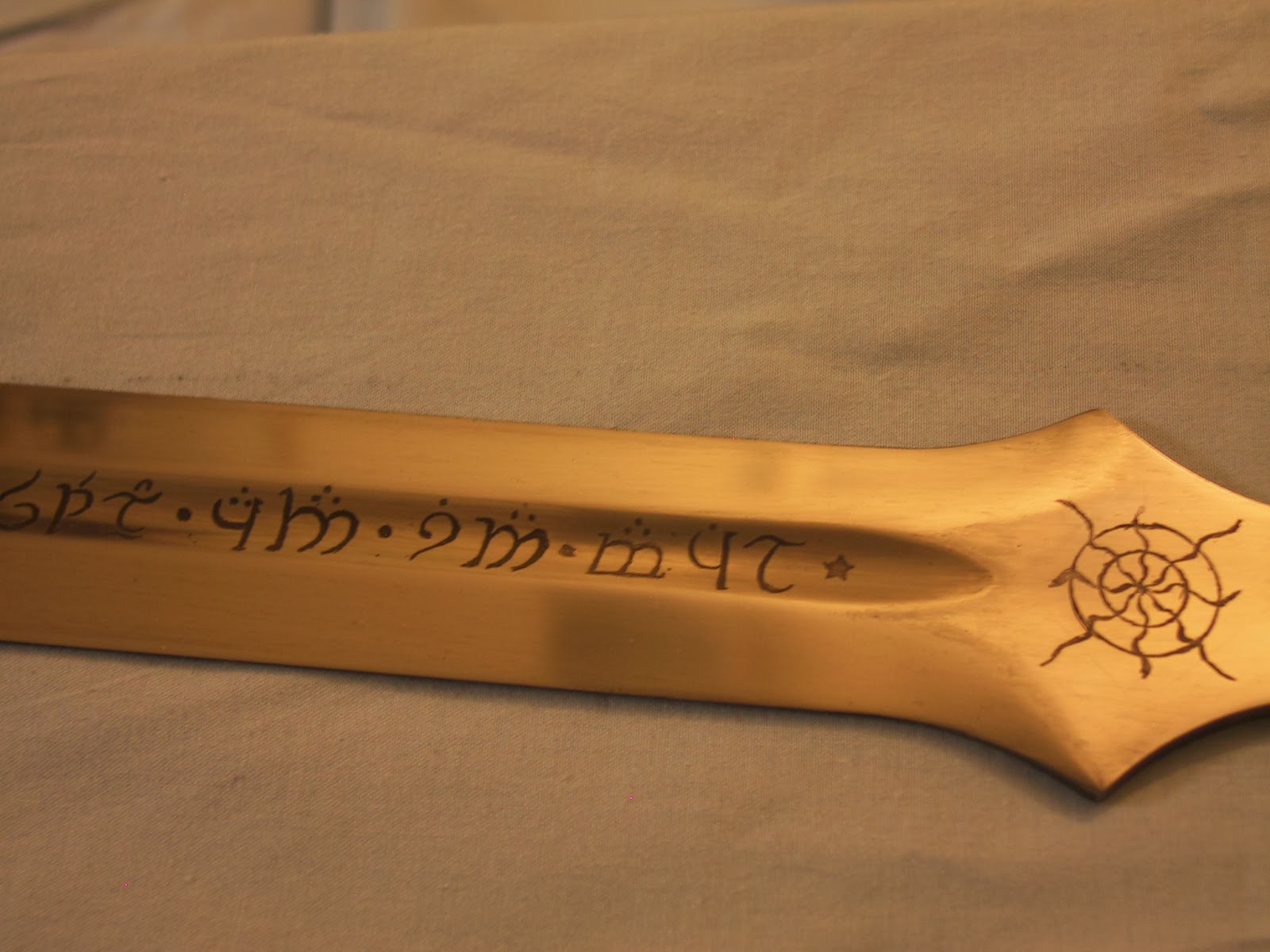
So I finally had the bare "Glamdring" blade in hand. What next? Well, the description in the Museum Replicas catalogue had this interesting tidbit: "Both the blade and pommel cry out for runes or other decorations, so we invite you to join in and elaborate on the creation of this fantasy sword."  (emphasis added)

Oh, really? Well, challenge accepted!

At this point all those many years ago I had not really settled on a hilt design, but it occurred to me that I could at least decorate the blade with "runes or other decorations." And so I began a mini-journey to develop a "runic" inscription and other decoration that I felt would be consistent with J.R.R. Tolkien's Middle Earth. Actually, this proved to be a more extensive travail than I initially realized!

The first part of this self-imposed quest was to develop a brief "back-story" for this sword. That almost overstates it, though. Mostly I just wanted to place it in a setting within Middle Earth that would be internally consistent with Tolkien's writings, which would also drive both the alphabet and the language used to make the inscription, as well as the content of same. I decided to make it a sort of "mate" to the well known swords from The Hobbit and Lord of the Rings, namely Orcrist and Glamdring, thus placing it within the hidden kingdom of Gondolin in the First Age during the War of the Jewels.

As I wanted a Quenya rather than a Sindarin inscription, I decided that the sword was forged in Nevrast, as opposed to being made in Gondolin proper, since the Ban on Quenya that arose after the revelations about the Kinslaying in Aqualonde would have virtually mandated the use of Sindarin (as was done, apparently, with Orcrist and Glamdring - though in a late writing Tolkien states that King Turgon and his immediate household disregarded the Ban and used Quenya anyway).

With the language settled, I proceeded to come up with a name. I went through a number of possibilities, some inspired by the MERP supplement Treasures of Middle Earth, but in the end settled upon a name of my own invention, "Helkaluinil", which is Quenya for "Ice Blue Star." The inscription in the Tengwar script looks like this:

I then came up with a secondary inscription for the other side of the blade. It simply reads,
ni Mithlor Nevrastello kanta sina makil.” which translates as, "I, Mithlor of Nevrast, made this sword." Note that the smith's name, Mithlor (stated to be a master Noldo smith of Gondolin in the MERP supplement Elves), does not appear to be one that Tolkien invented. The Tengwar script reads thusly:
There was one other detail I wanted to include, namely heraldic devices appropriate to the House of Turgon. Well, Tolkien never actually drew one for Turgon, though he did draw them for his father, Fingolfin, and Idril Celebrindral, his daughter:


Based on these two examples, I extrapolated a hybrid that has features of both, to approximate what might have been Turgon's which I then etched in outline only onto the sword blade with ferric cloride (note that I never finished coloring the emblem, since I only needed the outline, though I think I will make an effort to finish it for posterity; I will post it as an addendum to this series when I get it done). Here then is the end result:


Note that the side with the sword's name has this hypothesized House of Turgon emblem, while the side with the maker's inscription has that of the House of Fingolfin. It is also worthwhile to point out that both emblems largely follow the rules of Elvish heraldry, in that they are basically "square" rather than "lozenge" oriented, as befits a general depiction of a house allegiance, as opposed to a personal emblem.

With that complete, it would be years before further progress was made. To be continued in Part Three...


Friday, December 13, 2013

(Mostly) OT - Why Public Funding of the Arts is Unnecessary

For the most part, this is a politics-free blog. However, I recently ran across a Facebook post from an friend of mine that, while purely political in nature, has aspects that touch upon subjects that are directly covered in this blog, and so I decided to address it.

As can be gathered from the title, this post deals with public (i.e. taxpayer) funded art, and one might also further discern my distaste for the idea, hinting at my Libertarian viewpoint on such matters. Here, then, is what my friend, to be known henceforth as "E.E.D.," had to say on the matter:

"I had the dubious pleasure of hearing a radio debate this morning on privatizing funding of the arts, while decreasing public spending here in Norway. As someone who has experienced this type of thing first hand, welcome to the age of corporate crap rock and boy bands (you know, that which sells), starving artists and struggling arts media. And that Norwegian debates so frequently point to the US, a society clearly in stunningly rapid decline, as a shining beacon for the way forward in Norway is nothing less than idiotic. I shudder to think."

This view is incorrect, on a number of levels. Before I go much further in explaining why, though, it is important to point out that there are two problems that public funding of the arts supposedly solves, both of which are alluded to above. The first is the fear of diminishment or watering down of art, in order to appeal to the widest audience, thus maximizing profit. The second concern is with the ability of an artist to earn enough money at their craft in order to survive. I submit, however, that both of these fears are misguided.

So I oppose the National Endowment for the Arts (NEA). Why? Here are the main reasons, in ascending order of importance.

Reason No. 1.: Some of the "art" that public funding is used for is quite honestly distasteful and a waste of money. The most infamous example I can think of is "Piss Christ", wherein a crucifix was suspended in a jar full of urine. As disgusting as that is, from a sanitation standpoint, if nothing else, the really obscene part was that the NEA actually gave the "artist" (and I'm using the term in the widest possible sense) a grant of $5,000 for something I could have done for as little as $5 (a bit more, though, if I drank quality beer to fill the jar with...) 

Reason No. 2: While art is actually important to the human psyche, it is in no way as important as, say, air, water, food, shelter, property rights, etc. Simply a matter of healthy prioritization.

Reason No. 3: It gives government the power of defining what is art. The Soviet Union's Proletkult and Nazi Germany's Reichskulturkammer are stark warnings from history about having government mess around with art. I'd rather have "corporate crap rock and boy bands" then a bureaucrat with a bad comb over promoting his idea of "art," which invariably will be nothing more than State sponsored propaganda. Seriously, people, read a fraking history book once in a while. Yes, I know the NEA does not (yet) reach the extremes outlined in the aforementioned examples, but it ultimately suffers the same taint and bad precedent as the above. And given the extreme leftist tendencies of the NEA, they are more closely aligned with the Soviets and Nazis then most realize.

Reason No. 4: Sort of a parallel with No. 1, it needs to be understood that art is extremely subjective. One person's art is another's garbage, and vice versa. No one should have to fund art they do not like.

But the main reason I oppose public funding of art is simply this: the dramatic decrease in the cost of production for art, along with crowdfunding initiatives to raise any needed funding, has rendered the NEA utterly and completely obsolete and unnecessary. Consider the following case studies/examples:

1. A group called the "H.P. Lovecraft Society" (http://cthulhulives.org/) has released two films based very closely on stories penned by that author, Call of Cthulhu and Whisperer in the Darkness, and has a third one in work (The Statement of Randolph Carter). The released films were done to a very high standard on a very minimal budget. In addition, they also have produced some "radio broadcast" adaptations of Lovecraft's stories as well.

2. A branch of Regia Anglorum up in Northern California used Kickstarter to fund a movie, The Frost Giant's Daughter, based on the Conan short story by Robert E. Howard (http://www.kickstarter.com/projects/guignol/robert-e-howards-the-frost-giants-daughter). They requested a mere $5000 for it on Kickstarter. (Admittedly there have been some post production delays, sadly, but I think eventually they will complete the project. Note also that this was the same amount "required" for Piss Christ in order to procure a jar, urine, and a plastic crucifix... and you libtards whine about $600 hammers for the military!)

3. There are a whole slew of purely fan produced Star Trek shows:
Star Trek Phase 2 (bunch of episodes up on YouTube)
USS Exeter (http://www.starshipexeter.com/)
Starship Farragut (http://www.starshipfarragut.com/)

4. Fans of the TV series Veronica Mars were able to use Kickstarter to fund a new season.

5. Kickstarter was also used to raise funds for the movie Atlas Shrugged.

6. In the role-playing and war- gaming community, there have been numerous small Kickstarter efforts for various rulesets and accessories, such as adventure modules, miniatures, etc. For example, there is a Kickstarter to sculpt and produce "Old School" Dungeons & Dragons minis based on the original 1st Edition AD&D rules and primarily inspired from drawings in the old 1st edition Monster Manual).

What is so fascinating about the above examples is that none of them are at all "mainstream" (apart maybe from Veronica Mars, and even that was not a really mainstream show); indeed, most are nothing more than a very tiny fringe. While most people have heard of Conan the Barbarian, hardly any have ever read or are even aware of the original short pulp fantasy stories that were written back in the 1930's, knowing of the fictional character only through the movies. Along those lines, how many people on the streets have even heard of H.P. Lovecraft, let alone actually read any of his stories?

Even more interesting is that these are often the efforts of purists, who want as close a translation of the original artist's work as possible, and invariably achieve very high standards that mass produced art generally fails to meet. For the Lovecraft movies they actually produce them in the style of film that would have been extant at the time the story was written; for example, Call of Cthulhu is done as a silent film in black and white. The impetus for The Frost Giant's Daughter arose from a general feeling among Robert E. Howard fans that the popular movies (and TV show) fell far short of the original stories. The Star Trek fan efforts invariably cleave very closely to the original 1960's series, and use props and special effects of the same or even better quality than what we saw in 1966, and yet at a fraction of the cost. Indeed, given that a modern laptop has *orders* of magnitude more computing power than computers that took up entire rooms, it is trivial to do pretty good special effects on a shoestring (or even non-existent) budget.

Put another way, the "purity" of these art endeavours vastly exceeds anything put together by the so-called professionals.

The above examples only pertain to the quality of non-public funded art, however. The other half of the problem is how to make a living doing art. Once again, the solution is not to be found in a bloated, corrupt, inefficient, and useless government agency. Rather, the solution is to be found in a vibrant and affluent free market. Put another way, you need a sufficiently wealthy populace who can afford the luxury of art consumption to provide a large enough customer base to support you in the pursuit of art.

Unfortunately, the philosophy of "progressivism" (read: socialism, communism, marxism, nazism, etc.) that supports the NEA invariably breeds near universal poverty, not prosperity. You end up taking money from the very folks who would support art, and give it to those who could care less. Don't believe me? Look no further than South vs. North Korea. One is a prosperous capitalist land, the other a dreary, impoverished hell hole, supposedly a "Workers' Paradise". And yet "progressives" want to turn the United States into North Korea, for reasons that are incomprehensible to anyone who is remotely sane.

Historically, one of the greatest explosions of art was during the Renaissance. Why? Because thriving trade gave rise to a wealthy merchant class that could afford to purchase fine art on a grand scale. It was not the deranged ravings of Karl Marx that brought this beauty into the world (and made artists themselves wealthy), but rather the ability of otherwise ordinary people (i.e. outside of the nobility or upper echelons of the Church) to gain this degree of wealth.

Let me give a personal example: as can be seen from other posts on this blog, I make reproductions of Mediaeval arms and armour (among other period crafts). My stuff is good enough that I could almost make a business out of it. Notice I say "almost". The problem is not so much lack of interest but lack of money on the part of would be patrons. I can do a fine reproduction of a Vendel period helmet, but most can't afford the $1000-$2000+ sticker price. In a world where success is punished by high taxes, which further destroys job opportunities for everyone else, few people can afford my (or anyone else's) art.

Going further, as someone who has been laid off as a direct result of Obama and the democrats and their "progressive" policies, I no longer have the income to purchase art. I'd really like to get, for example, the H.P. Lovecraft society products, but cannot.

Again, for the progressive knuckleheads out there, art is a LUXURY, not a necessity. Thus, one must make a significant degree of SURPLUS WEALTH in order to be able to purchase art, and thus keep ARTISTS EMPLOYED!

Put another way, STOP TAXING EVERYONE TO DEATH YOU MORONS!!!

Monday, October 7, 2013

TFT's Master of the Amulets - Review and Revised Map

In 1981 Metagaming released their 7th MicroQuest, Master of the Amulets. Unlike the previous six, this one attempted to get away from using a pre-programmed adventure, relying on random placement of objects and die rolls to make each adventure unique. The main flaw of the pre-programmed MicroQuests was that they could really only be run through once and then all the mystery is gone. Since everything was random in MotA, there was no chance of that happening.

Of course, this meant that there wasn't much of an adventure, either. Worse, there wasn't much variety in encounters, with only a relatively small selection of critters (dragons, giants/ogres, gargoyles, giant snakes, wolves, trolls, bears, and "serpents", the one original monster introduced for this MicroQuest) and a limited number of random Fighters and Wizards. At barest minimum, then, the random encounters should have had a wider range of creatures that could be encountered.

As written, this MicroQuest seems to have been geared more towards basic Melee and Wizard, or perhaps the Dragons of Underearth summary TFT ruleset, then the Advanced modules and In the Labyrinth. There are some references to certain spells and talents, but overall it appears that ITL was an afterthought.

In his review in Space Gamer No. 49 Stefan Jones comments that had this MicroQuest come out before the release of ITL and the advanced combat/wizardry modules, this would have been "...state of the art adventure technology." But being released after put it in conflict with, for example, existing overland travel rules, along with some other small but important rules in ITL, such as how experience is accumulated, the use of gold bars for treasure (after the manner of Death Test), the nature of the amulets themselves, which does not comport with magic item rules as given in Advanced Wizard, and a few others.

This makes me conclude that this adventure was written and submitted for publishing prior to the release of ITL, but was delayed for some unknown reason. This explains not only the rules conflicts, but also the lack of any mention of Cidri, the giant game world that is home for most of the adventures written for The Fantasy Trip, sort of like "Greyhawk" for early Dungeons & Dragons (the main exceptions being Grail Quest, which is Arthurian Britain, and the Treasure of Silver Dragon and Unicorn Gold, which take place on the Dragonodon Earth).

As far as adventures go, this Master of the Amulets is only so-so. It could be improved, though, with the addition of more varied encounters, as noted previous. Optionally, if using the ITL Talents rules, one could include rules for gathering food and so forth by means of the Woodsman talent, with parties not so supported having issues finding food, etc. Another possibility might be to have hexes with ruins that could be randomly generated for type and accopanying encounters, with perhaps more challenges but better chances for treasure. Maybe have special encounters near river hexsides that allow the party to capture a boat. Lots of possibilities, really.

One improvement I will share, though, is a corrected map. As released the "ENTER" hex, along with the "X's" on four of the hexes where one places the amulet counters, were missing. I have through various diabolic means corrected these problems, and make available here this map. Be sure to go into the options when downloading it to get the full size version. Enjoy!

Wednesday, October 2, 2013

Proposed Metagaming The Fantasy Trip Material

This article focuses on TFT Material that was either being planned or about to be published at the time of Metagaming’s demise. There were a lot of interesting ideas in the pipeline, including a variety of adventure and rule supplements for the game. Much of this information was obtained from letters and status reports by Kevin Hendryx, written in early 1982, and also Interplay and Space Gamer magazines.

1.    [Worlds/Nations/Realms] of Cidri
A final title had not been decided on at the time of the proposal. This supplement would have been aimed at the Game Master and would cover outdoor/wilderness adventuring. Included would be information on how to organize and establish a nation/continent/ world, movement and scale in the wilderness, random encounter tables (scaled according to terrain and climate conditions), descriptions of regions and states suitable for adventuring in, some new monsters, and mini-adventures or scenarios to get the GM started on a campaign. This supplement might also have included topographical maps. Note that Interplay No. 5 had an article pertaining to the in-game effects of winter conditions. (ref: Product Proposal letter by Kevin Hendryx dated 3/16/82 and Status Report by Kevin Hendryx dated Feb ’82. See also Interplay No. 5)

2.    Affray
This proposed TFT Aerial combat module developed by Ian Bell; was in playtest and evaluation as of 2/19/82. This was originally requested in Interplay, to cover aerial combat between creatures, specifying that "The best approach is to do something that plays well but doesn't try for realism." (ref: Status Report by Kevin Hendryx dated Feb ’82 and Interplay No. 2)

3.    Ultra Force – In the Name of Justice (a.k.a. “Herodium” or “In the Name of Justice”)
Comic book super-hero TFT supplement by Peter Christian. In Interplays No. 3 & 7 a different title, “In the Name of Justice” was given, and Interplay No. 8 gave the title as “Herodium” However, Scanner in Space Gamer No. 61 gives the final title. The target price was $7.95, the same as Conquerors of Underearth and Dragons of Underearth, implying that it would have been released in the same MetaGame style format. According to Scanner, this was planned for a late spring release. (ref: Status Report by Kevin Hendryx dated Feb ’82, Space Gamer No. 61, and Interplay Nos. 3, 7, & 8. See also Space Gamer No. 65 for Ronald Pehr’s article on this subject of Superheros)

4.    Nosferatu
Adventure supplement designed by John Sullivan. This was not regarded as requiring too much time to edit. Note that Interplay No. 3 had an article entitled “Vampyre” by the same author; presumably Nosferatu would have used elements of this article. (ref: Status Report by Kevin Hendryx dated Feb ’82 and Interplay No. 3)
5.    Infantry
Listed as a Modern Military RPG - probably intended to be a TFT supplement as a blurb in Interplay mentioned that a WWII supplement was in the works. Authored by Thomas Trunzo (ref: Status Report by Kevin Hendryx dated Feb ’82 and Interplay No. 1)

6.    The Runesword of Regalan (a.k.a. Runesword at Regalan)
TFT MicroQuest by Anthony Affrunti, intended for release in March 1983 at a price of $2.95, which was a dollar off from the usual $3.95 price tag for Micros at this time. It is not clear what the actual title was, as the two sources give it slightly differently, but Kevin Hendryx gives it as “Runesword of Regalan,” and this is likely the correct version. (ref: Status Report by Kevin Hendryx dated Feb ’82 and Space Gamer No. 61)

7.    Prison of the Spectral Demon
Another MicroQuest by Robbins and Wittke, intended for release in March 1983 at $2.95. (ref: Status Report by Kevin Hendryx dated Feb ’82 and Space Gamer No. 61)
8.    Pthantium Hall
This was a MicroQuest authored by Robert Schlott. No other information is available. (ref: Status Report by Kevin Hendryx dated Feb ’82).

9.    High Noon
TFT Western gunfighter supplement by David Tepool. This was regarded as a big undertaking, and one of the problems they were having was a lack of suitable playtesters. This product had been officially accepted for $500. Note that Interplay No. 2 published a rules set called “TFT: Wild West” by Fred Askew; not clear if there was any relationship (ref: Status Report by Kevin Hendryx dated Feb ’82 and Interplay Nos. 1-3)

10.  Energy Crisis - Land Beyond the Mountains
THIS is a fascinating item. It is only referenced by title, unfortunately, but it is clear that they were looking at all sorts of adventures for the LBTM campaign. Likely set in Soukhor in a Mnoren ruin of some sort. Status report included this in a list of manuscripts “closest to being publishable”. It is interesting to note that this was in work months before either the Darok or Dihad modules had been published. Written by Keith Gross (ref: Status Report by Kevin Hendryx dated Feb ’82 and draft notes of same dated 2/16/82).

11.  Dragons of Underearth
Of course, this was published, but it is interesting that the original title was “Dragonslayer” and that Keith Gross was paid $750 for it. Note that the normal rate for a MicroGame was $500. (ref: Status Report by Kevin Hendryx dated Feb ’82 and Interplay Nos. 3 & 8).

12.  Tollenkar’s Lair Revision
Apparently they were thinking of revising the adventure. It appears that they intended to both update and expand the module, perhaps with better maps, adding counters, etc. (ref: Status Report by Kevin Hendryx dated Feb ’82 and Interplay No. 6). Certainly, I would have had any number of ideas for revising it; see my review here.

13.  Conquerors of Underearth
CoU (also called CUE) is mentioned as having been very close to publication – Scanner in Space Gamer No. 61 stated that it was due for a late spring release with an asking price of $7.95. Another Keith Gross game, this one at least was described in some detail, taken from a Designer’s Introduction to DoU by Keith Gross in Interplay No. 8:

-    DoU was actually a *byproduct* of CoU, but got published first owing to its simplicity

-    CoU was intended to be a combination MicroGame-MicroQuest

-     A full designer’s intro to CoU was intended to be published in Interplay No. 9 (which, naturally, never saw the light of day)

-    CoU was intended to use DoU characters on a LoU scale strategic map, with MicroQuest paragraphs

-    CoU dealt with adventurers entering a Goblin fortress and encountering organized military units, and as such involved 10-20+ warriors per battle

-    There was an implication that CoU was originally intended to be a TFT supplement, but because of the large numbers of combatants, use of AM/AW/ITL slowed things up too much, thus the decision to design a streamlined “Son of the Fantasy Trip”

-    Talents listed in DoU were going to be described in CoU


It was also mentioned that CoU could use more playtesting, and that some rules had been omitted from the manuscript that were considered critical to the continuity of the other Underearth games. Further, about twice as much editing would be required over DoU, since it is a complete game with scenarios rather than a set of RPG rules. Interestingly, a mass combat game of this sort had been envisioned from the very beginning; the Designers Notes article in TSG No. 12 specifically mentions the concept of a “wargame” version of TFT. The review of Dragons of Underearth in TSG No. 55 mentioned the fact that talents were going to be described within CoU. The 1981 Metagaming Catalog stated that this was to published in a MetaGame format. (ref: Status Report by Kevin Hendryx dated Feb ’82, Interplay Nos. 6, 7, & 8, Metagaming Catalog 1981,  and Space Gamer Nos. 12 & 55, and 61).

14.  Soldier City - Shaylle
This, interestingly enough, did get published as City of the Sacred Flame by GameLords, Ltd. for their Haven campaign under the Thieves Guild rules system. Originally written to describe the capital of Darok in detail, Gamelords rewrote it when Metagaming tanked by removing some of the TFT game mechanics and Land Beyond the Mountains background, but kept all of the basic encounters. There is, thus, a very noticeable “substrate” of TFT-LBTM material in the module, if you look closely. Certain mentioned spells, talents, and even creatures are straight TFT (one description of a pet “monkey” shows how quickly they edited it - at the end of the paragraph they forgot to put “monkey” in place of “slinker”, showing the original intended TFT critter). Indeed, one could rewrite it back to something closely resembling its original intended form. The hard part is figuring out the names and especially some of the historical background, as they ended up changing a lot of details to “fit” into the Haven campaign. Worse, since they only had the Darok and Dihad components, they made the two of them mortal enemies, rather than their mutual enemy, Muipoco. Of note is that the encounters that I have read through are actually pretty interesting and well thought out; it’ll take sharp players to catch what is really going on (ref: City of the Sacred Flame, Interplay No. 7, and 1/3/03 e-mail from author Walter Hunt, formerly of GameLords, mentioning how it was altered after HT cancelled the contract.)

15.  Intrigue in Plaize
As with “Soldier City” this was similarly rewritten by GameLords and published as Within the Tyrant’s Demesne. Originally intended for release in April of 1983. Detailed the capitol of Dihad. Again, this one could also be “restored” to something like its original state, though the initial impression is that this one seems trickier than the Shaylle module. The rewrite, according to Richard Meyer, took about six weeks. (ref: Within the Tyrant’s Demesne, Space Gamer No. 61, Fantasy Gamer No. 1, and 1/3/03 e-mail from Walter Hunt, formerly of GameLords, mentioning how it was altered after HT cancelled the contract.)
16.  TFT Yearbook
Published only once as the “Fantasy Master’s Codex” in 1981, it was intended to be released annually with updates, new material, errata, and so forth. It is strange that nothing was released in 1982.

17.  Campaign Guides
There was a stated intention to introduce TFT supplements to detail particular cultures, such as medieval Japan (“Samurais”) and China, Vikings, Egyptians, Aztecs, Zulus, Hellenes, Mongols, and Incas. Interest was also expressed in creating fantasy campaign backgrounds, to include new races, monsters, magic and so forth (ref: Interplay Nos. 1 & 2)

18.  Monster Manual
This concept goes back to the beginning, with mention of a monster manual in the Designers Notes article in TSG No. 12, which would incorporate (edited) gamer ideas. In a reply to a reader’s inquiry in Interplay, Trace Hollowell mentioned that some sort of a monster compendium was in the works, and William Gustafson also stated that a new monster book was to be the first book for a revised 2nd Edition of ITL. This was supposed to have a LOT of monsters. (ref: Interplay Nos. 3 & 4 and Space Gamer No. 12)

19.  Second Edition TFT/ITL
Mentioned in Interplay No. 4. William Gustafson was to be the author. No details given as to the kinds of changes that were to be made, though it is a safe bet that any “Steve Jacksonisms” would have been written out with extreme prejudice… (ref: Interplay No. 4 and Space Gamer No. 12)

20.  Religion Rules Supplement
This was requested in Interplay #2, and that it was intended to be “broad enough to handle all Terran religions and religions for other races” and emphasized that a separate form of magic should NOT be created. Paul Manz wrote a set of rules in Interplay No. 4 that were basically inspired by D&D (ref: Interplay Nos. 2 & 4; see also the Letters section in Interplay No. 7 for critiques of Manz’s article).
21.  Mounted Combat MicroGame
To be used with Melee to augment the fast rules given in Advanced Melee. The article in Space Gamer #18 predates publication of Advanced Melee, and is thus not really relevant (ref: Interplay No. 2 and Space Gamer No. 18).

22.  Ship Combat Module
Requested in Interplay No. 2 and intended to cover combat aboard and presumably between ships in TFT terms. Something like this based on Ramspeed appeared in Space Gamer No. 24. Interplay No. 6 mentioned that a new ship combat module for use with TFT was in the works, to be done by the Ramspeed game designer Colin Keizer (ref: Interplay Nos. 2 & 6 and Space Gamer No. 24)

23.  Building Rules
Intended to cover rules for construction, costs, time, etc. (ref: Interplay No. 2)

24.  Magazine expansions
Not really a supplement, per se. Interplay was slated to grow to 48 pages, with an increase in cover price. A TFT specific magazine was proposed as well, that would have been a full colour quarterly featuring an adventure in each issue and a cover price of 4 to 5 dollars. (ref: Interplay No. 5)

25.  Additional MicroQuests and TFT Campaign Modules
In the works were 4 to 6 new Microquests and 3 to 4 TFT campaign modules. It is likely that the campaign modules were for the Land Beyond the Mountains campaign. Some of the other material has probably been described above. (ref: Interplay No. 5)

26.  Trevalia
An offhand statement on p. 18 of “Warrior Lords of Darok” indicated that a supplement for this province, located somewhere west of Darok, over the mountains, was coming out “…when time permits.” Presumably a separate module might also have been written for this province’s capitol, Triyal, as was intended for the other LBTM materials. (ref: Warrior Lords of Darok)

27.  Starman
A tactical man-to-man future combat intended to be compatible with TFT - this probably became Starleader: Assault! (ref: Space Gamer No. 17)

28.  Medieval Siege Game
This was mentioned in Space Gamer but nothing seems to have come of it. While it was a stand alone MicroGame, there is a possibility that it might have been made TFT compatible, as was done with “Lords of Underearth”. (ref: Space Gamer No. 26)

29.  Khitin’s Hive
This title was noted on a Metagaming order form dated February 1982, with a scheduled release date of October 1982. This might have been a sequel of some sort to Chitin I, however, rather than a MicroQuest. (ref: Vindicator No. 2)

30.  LBTM Module for Muipoco
Mentioned in the introductions to Warrior Lords of Darok and Forest Lords of Dihad, it was supposed to come out later in ’82 - obviously that never happened! One wonders what “theme” this province would have had, and how they manage to survive fighting in a two front war (yes, the Soukhori are manipulating things, but there *has* to be some superior military capability to provide a basis for success). Since the Darok module had a focus on warriors and battle magic, and Dihad on magic and trade, one would surmise that Muipoco had something of both. Their military is implied to be quite good, perhaps at a Renaissance level with a professional mage corps for magical support - maybe a little like Venice in the 16th century, but with sorcery. This is reinforced by the references to gunrunners in the Dihad module. Perhaps the title could have been either “Warlords of Muipoco” or “Merchant Lords of Muipoco”? Both have a certain ring to them, but I have no idea what might have been. (ref: WLD and FLD)

31.  LBTM Module for Soukhor
Also mentioned in WLD and FLD; would have been released at the same time as the Muipoco module. This one, at least, is a little easier to get a grip on - obviously a heavy focus would be on excavating Mnoren ruins and investigating various technological artifacts. I can even hazard a credible guess at what the title may have been: “Tech Lords of Soukhor”. In fact, I will go one step further and propose cover art for the module: have a king or ruler sitting on throne, contemplating an offering brought in by some peasant, who kneels before him holding up a broken TV; flanking the throne are a pair of Reptile Men, armed with halberds and large six-shot revolvers strapped to their sides. A hodge-podge of modern items may be seen displayed as trophies on the walls of the room, including random car parts, a stop sign, a computer printer, a bazooka, etc. (ref: WLD & FLD)
32.  Microquest Sequel to Silver Dragon and Unicorn Gold
Howard Thompson stated the following in his designer’s notes: “TREASURE OF THE UNICORN GOLD is a sequel to TREASURE OF THE SILVER DRAGON. UNICORN is the second of a planned treasure hunt trilogy. The third hunt will come after the UNICORN has been found.” So, how does one top a Silver Dragon and Gold Unicorn, you ask? Presumably a Platinum something or another... Perhaps, in keeping with the Meso-American theme of the previous two MicroQuests, it might have been a Coatl, a feathered serpent of that culture’s mythology. Mention of a third quest is also made in SG No. 33 “News and Plugs.” Of course, this project might have been derailed by the problems Unicorn Gold ran into with the U.S. Forest Service, even if Metagaming had stayed afloat. (ref: Space Gamer No. 33 and Interplay No. 3)

33.  The Inner Sea
TFT Campaign supplement by Jack Burlin. Was playtested by Bill Gustaphson and awaiting final decision from Thompson. Alas, no further information is available. (Source: Status Report by Kevin Hendryx dated Feb ’82.)

34.  The Kanirvan Conspiracy
This proposal by Kevin Hendryx has a convoluted history. The genesis of this supplement goes back to when Kevin was working at TSR. He had been assigned the task of rewriting Len Lakofka’s original manuscript for The Secret of Bone Hill, which had been deemed “unsuitable” as submitted. Kevin’s rewrite was very extensive, and also expanded upon the original scenario by adding a new dungeon inhabited by an evil cleric and his lizard men minions. When Len heard about the rewrite, however, he contacted Gary Gygax and protested. Gary then ordered the design department to simply edit the original submission. Thus, Kevin’s rewritten material was discarded. So as not to waste all of this effort, however, Kevin resubmitted the dungeon and plot as a separate module, Against the Cult of the Reptile God.
When Kevin resigned from TSR and went back to Metagaming, he took this proposal with him, reworking it and renaming it to The Kanirvan Conspiracy. But somewhat soon afterwards, Howard Thompson decided to eliminate his design staff, and by early 1983 Metagaming folded, and this proposal was never realized.
Curiously, TSR had not forgotten about the concept, and in late 1982 the published it as module N1.

35.  The Forest Oracle
Another proposal by Kevin Hendryx that was originally made to TSR but later made to Metagaming when he came back there. Later published by TSR as module N2. It is not clear if this was part of the rewrite to the original Secret of Bone Hill manuscript, or a separate proposal altogether. Also unknown is whether this was the title proposed to Metagaming, or if Kevin called it something else.

36.  Sword of the Jorisseri
Written by Jeff Edmunds. Not clear if this is TFT or not; the note indicated that it was “un-publishable as is” but also that it had been “accepted, unfortunately.” Likely was a MicroGame, rather than a TFT related item, but it is mentioned here in the off chance that it was TFT related (ref: Status Report by Kevin Hendryx dated Feb ’82).


Other Material that Could or Should have been in Work:
According to the Introductions to WLD and FLD, companion volumes detailing the life and denizens of the capitol cities for Muipoco and Soukhor were also to be published. As a point of fact, though, neither of these two provinces were sketched out beyond the most hazy of outlines, according to Gamelords president (and, as he put it, “chief bottle washer”) Richard Meyer in personal communication. Going beyond that, one might envision supplements or MicroQuests involving Skull Rock in Darok, the Dwarven city of Rhuz in the Asenborgs, or Mnoren ruins in Soukhor (as noted previous one may suspect that this last may have been the root of the Energy Crisis module - would that more information was available on it). There certainly was plenty of room for further development, here.
One might think that more MicroQuests or even a Campaign Module might have been called for as a sequel/expansion to either or both of the Death Test/Orb Quest and Silver Dragon/ Golden Unicorn series. For example, I could see a MicroQuest to bring down whoever it was that was gathering the Orbs and attempting to bring down the Thorsz, or a module along the lines of WLD or FLD to expand the Dragonodon gameworld.
Elyntia could also have supported a number of modules, if only for the Duchy of Dran, the Gargoyle Mountains, and so forth. An expanded map would have been nice, as well, to show where everything (i.e. LBTM, Elyntia, Tanander, Underearth) was located in relationship to one another. Of course, that might well have been covered in Kevin Hendryx’s proposed “Realms (or whatever) of Cidri.”
It is also to be noted that Steve Jackson apparently had some additional material for TFT/Cidri. In his article regarding the development of TFT and errata for the published game in The Space Gamer No. 29, July 1980, Mr. Jackson stated that: 
“One supplement that I designed, and several that I edited, are at Metagaming now and may eventually be published. There is dispute over the status of another supplement originally designed for TFT. I have literally reams of notes that were intended for later TFT games or supplements. If these ever are used, they will probably appear in a generalized form, suitable for any fantasy system.”

One can only speculate as to whatever became of the supplement that he designed; it is obviously something apart from Death Test II. That last statement regarding “reams of notes” is particularly interesting; it would suggest that at least some of the material that ended up in the original release of GURPS, including perhaps Caravan to Ein Arras, All in a Night’s Work, (both of these in the original GURPS boxed set) Orcslayer, and GURPS Fantasy, were perhaps modified from their original TFT/Cidri form and put into GURPS instead.


Conclusion:
Amazing what might have been, particularly when one considers the genuine quality of Orb Quest and the Land Beyond the Mountains modules, (to include the final capitol modules intended for Darok and Dihad). Why oh why couldn’t Thompson have waited a couple of months (at least) to close the doors! Think of it – Ultra Force, Conquerors of Underearth, Runesword of Regalan, and Prison of the Spectral Demon, along with Intrigue in Plaize, and Soldier City: Shaylle in their originally intended forms, would all very likely have been released, along with perhaps another issue or two of Interplay. Alas for TFT fans everywhere! What a tragic and inexcusable loss.
One has to wonder what held up publication of some of the above, though. For example, both Conquerors of Underearth and Nosferatu were apparently nearly complete back in February of 1982. Surely they could have gotten them done well before Metagaming collapsed over a year later! One becomes even more perplexed contemplating the six months between the release of Interplay No. 8 (the last issue) and the closing of Metagaming - even considering that the last issue was delayed owing to the company’s move they still should have managed one or even two more issues. It does make one curious as to what was going on internally at Metagaming from March 1982 to April 1983 when they officially ceased operations - obviously the collapse was not sudden, and had been building for some time.
Also of great interest are the hints of a 2nd Edition ITL. I wonder how far along they had gotten when Metagaming went under? One also wonders what sort of direction they were going to take the game in terms of rules changes, new material, etc.
As an aside, I wonder if manuscripts for any of these proposed games, supplements, or MicroQuests survived, and might be available in some fashion or another? Or at the least more useful descriptions of some of the un-described materials, perhaps related by the authors themselves (if they can even remember after all these years). If anyone has any additional information, or knows someone that does, now is a good time to come forward! I would pay hard cash for any surviving draft manuscripts, for their collector’s value.